How Executive Control and Mindfulness Protect Against Stress and Depression

Two people can experience the same stressful event, yet one quickly regains emotional balance while the other develops prolonged distress.
Executive-control networks, particularly those involving the prefrontal cortex (PFC) and anterior cingulate cortex (ACC), help regulate attention, emotion, and goal-directed behavior. Rather than reacting automatically to every stimulus, these systems allow us to redirect attention, inhibit impulsive responses, and recover after distraction.
The figure below summarizes few studies that explain how mindfulness based interventions may influence these systems and why they are relevant to stress resilience.
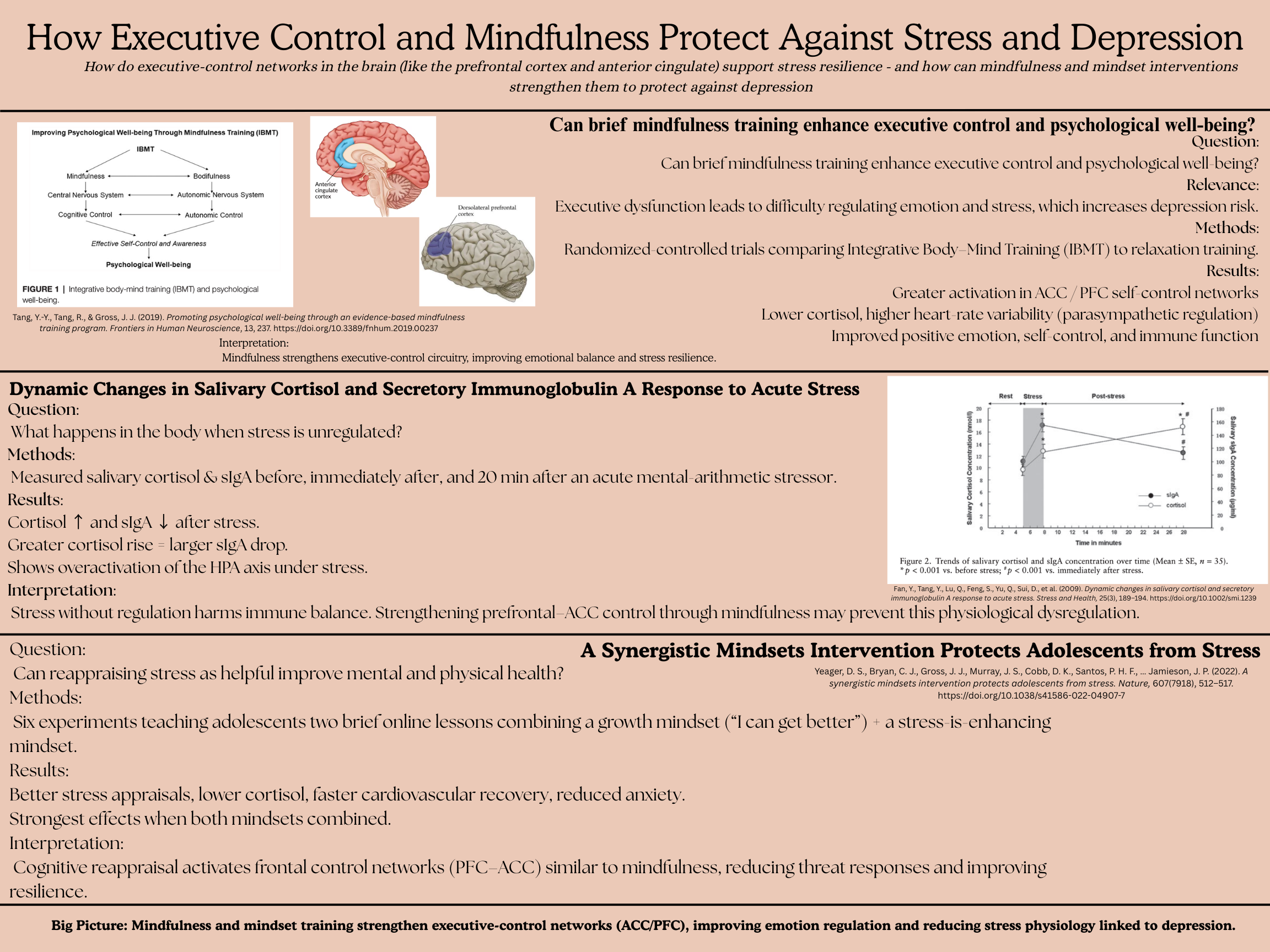
Figure 1. Conceptual synthesis of studies examining executive control, mindfulness training, physiological stress responses, and psychological resilience. The figure was made by author as an educational summary of the cited literature.
Can Mindfulness Strengthen Executive Control?
Researchers led by Dr.Yi Yuan Tang investigated whether Integrative Body–Mind Training (IBMT), a brief mindfulness intervention, could improve executive control and psychological well-being.
Across randomized controlled trials, participants who completed IBMT demonstrated improvements in measures associated with executive-control function compared with relaxation training. These changes were accompanied by physiological markers including lower cortisol concentrations, higher (HRV) heart-rate variability, and improvements in positive emotional states.
Together, these findings suggest that relatively brief mindfulness interventions may influence both cognitive control and stress-related physiological processes.
What happens when stress is unregulated?
Stress is not just a psychological experience, it gives us quantitative physiological changes in body.
In another study, researchers examined how acute mental stress altered salivary cortisol and secretory immunoglobulin A (sIgA), two biomarkers related to the body's stress and immune responses. Participants completed a demanding mental arithmetic task while saliva samples were collected before, immediately after, and twenty minutes following the stressor. As cortisol levels increased, sIgA levels decreased, suggesting that acute stress temporarily shifted physiological systems involved in immune regulation.
Although this experiment did not investigate mindfulness directly, it provides an important biological context, that chronic or poorly regulated stress has measurable consequences beyond subjective, purely mental experience.
Key Takeaway
Executive-control networks appear to play a very big role in regulating attention and emotional responses to stress. Mindfulness based interventions may strengthen these processes, although the precise neural mechanisms remain an active area of research.
Why this matters for my Research
The studies discussed above motivate my broader interest in understanding how executive-control systems can be measured, modeled, and eventually supported through personalized interventions.
Rather than viewing mindfulness as a standalone technique, I am interested in how attention, stress regulation, and computational models may be integrated to create adaptive systems that improve mental well-being.
Future articles will explore these questions further.
Research Reflection
Help improve this research by contributing an anonymous response.
Estimated time: 30 seconds